
Website & CRO
Website Development Cost in Bangladesh: What Affects the Price in 2026?
Understand website development cost in Bangladesh by project type, design, CMS, integrations, e-commerce, custom development and ongoing support.
The Short Answer
Current Bangladesh pricing guides show an extremely wide range. A simple brochure site can be offered for under BDT 20,000 by a freelancer, while a professionally designed company site, e-commerce build or custom web application can move into six figures or much more.
Several 2026 local price guides place a professional small-business website roughly in the BDT 20,000-90,000 planning range, while custom applications and larger commerce projects can extend far beyond that. These are market examples, not fixed rates.
The phrase “website development” hides too many variables for one number to be meaningful.
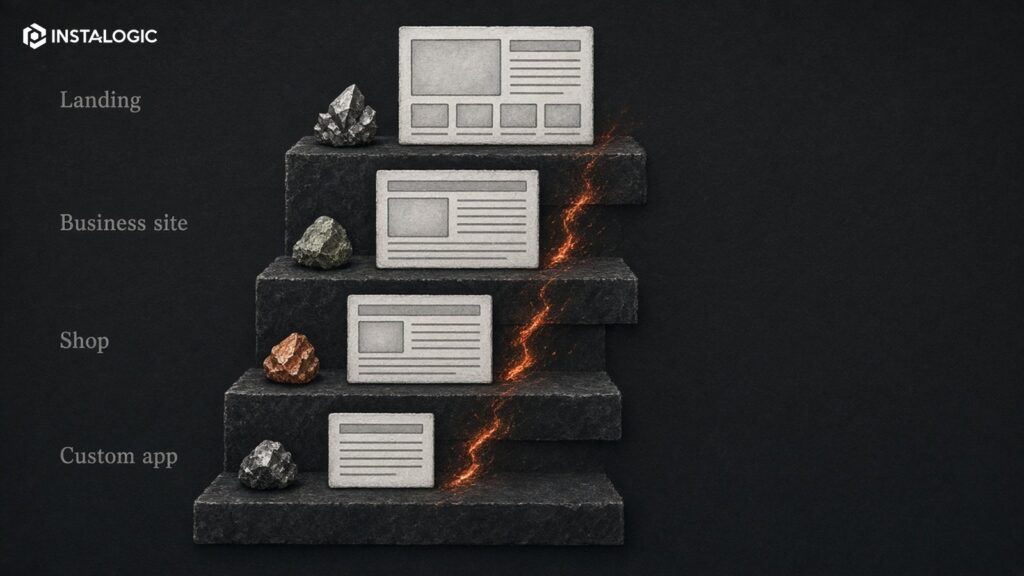
Start by Identifying the Website Type
- Landing page: One focused page for a campaign or offer. Cost depends on custom design, copy, tracking and integrations.
- Company website: Usually several service/about/contact pages with a CMS, responsive design, forms and analytics.
- Content / publishing site: Needs stronger content models, categories, search, editorial workflows and performance.
- E-commerce: Adds product data, cart, checkout, payments, inventory, shipping and ongoing operational complexity.
- Portal / web application: Adds accounts, roles, workflows, databases, APIs and custom business logic.
- SaaS product: Requires product architecture, authentication, billing, application UX, QA and ongoing releases.
What Actually Drives the Price
Custom design costs more than adapting an existing template because information architecture, wireframes, responsive layouts and component systems require design time.
Content also matters. A site with 15 pages of approved copy is very different from a project where the agency must research, write and migrate 300 pages.
Then there is functionality: multilingual content, booking, CRM integration, calculators, dashboards, payment gateways, product filters, member areas or custom APIs can each change the scope significantly.
WordPress vs Custom Development Cost
WordPress can be cost-effective when the project fits a content-management model and does not require unusual application logic. A good custom WordPress build still involves design, theme development, testing, security and performance work, so “WordPress” does not automatically mean cheap.
Custom development makes sense when the business process is unique: complex workflows, integrations, user roles, dashboards or product functionality. The initial build cost is usually higher, but forcing complex business logic into the wrong CMS can create higher maintenance cost later.
Choose the platform based on requirements and ownership, not on fashion.
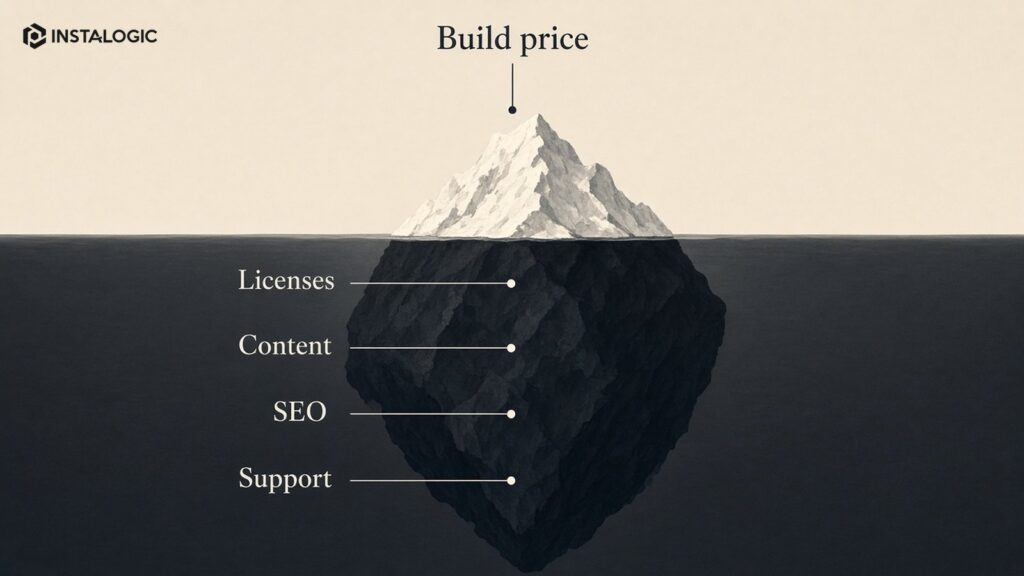
Hidden Costs Buyers Often Miss
- Domain and hosting
- Premium plugins, themes or third-party licenses
- Copywriting and content migration
- Photography, illustration and video
- SEO migration and redirect mapping
- Analytics and conversion tracking
- Payment gateway or SMS/email provider fees
- Security monitoring and backups
- Post-launch maintenance and support
- Future change requests
Why Very Cheap Websites Can Become Expensive
A low initial price often means using a template with minimal customization, limited QA and little time for content, performance or conversion. That may be perfectly acceptable for a temporary or low-risk site.
The problem appears when the business expects the site to become a long-term marketing asset. Poor page structure, slow performance, difficult editing, plugin dependence and missing analytics can require a rebuild sooner than expected.
Judge total ownership cost, not only launch cost.
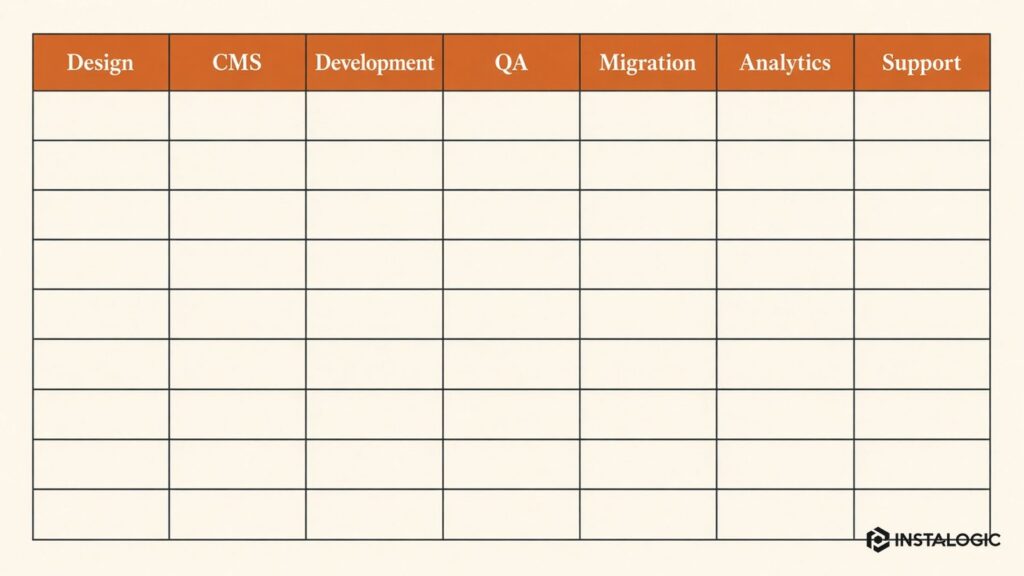
How to Compare Website Quotes
Ask every vendor to quote against the same brief. Specify the page types, content responsibilities, CMS, integrations, languages, forms, analytics, migration and support.
Then compare what is actually included: discovery, UX, visual design, responsive states, development, QA, content entry, SEO migration, deployment and warranty.
A BDT 40,000 quote and a BDT 100,000 quote may be surprisingly similar after you add all the excluded items to the cheaper option.
How Instalogic Thinks About Website Budget
Start with the job the website needs to do. A lead-generation site should be designed around buyer questions and conversion paths. An e-commerce site needs operational reliability. A SaaS site needs to explain a complex product while integrating with the product funnel.
Once the role is clear, choose the simplest architecture that supports the requirement and expected next phase. Overengineering wastes budget; underengineering creates expensive rework.
The right website budget is therefore a scope decision before it is a price decision.
Include those expected costs in procurement. A slightly more expensive build with clear documentation and maintainable architecture can be cheaper over three years than a low-cost site that requires repeated emergency work.
Ask the developer what they recommend for the first 12 months after launch. The answer should cover who handles security issues, minor fixes, content changes and larger feature requests. A maintenance plan can be lightweight, but there should be an owner.
Websites are not static purchases. WordPress needs updates, backups and security monitoring. Custom applications need dependency upgrades, infrastructure maintenance and bug fixes. E-commerce sites need ongoing integration and payment/shipping support.
Budget for Maintenance From Day One
Also distinguish launch scope from lifetime scope. A low initial price can be appropriate for an MVP if the architecture supports later change. Problems arise when the first version is sold as a complete system even though important operational requirements were excluded.
For a content website, ask how many unique templates/components are being designed and built. For e-commerce, ask about product data, payment, shipping, search/filtering and order operations. For a web application, ask which workflows, roles and integrations are included in the first release.
A BDT 60,000 template-based company site, a BDT 60,000 custom WordPress build and a BDT 60,000 first phase of a custom application can have completely different deliverables. The price tells you almost nothing without the scope.
Three Website Budgets That Look Similar but Are Not
A Simple Website Cost Estimation Worksheet
To estimate a website before contacting vendors, count the unique templates rather than only the number of pages. A 40-page site might use six templates: home, service, industry, case study, blog article and contact. A 12-page site might require twelve unique layouts and therefore more design work. Template complexity is a better planning signal than raw page count.
List each integration separately: CRM, payment, booking, ERP, search, authentication, analytics, newsletter, chat or external APIs. For each one, note whether documentation exists and whether the third-party service has a sandbox/test environment. Unknown integrations create estimation risk and should be identified early.
Then estimate content readiness. Are copy, images, product data and translations complete? If not, decide whether the agency will create them and include that work in scope. Content migration can become a major project on an established site, especially when formatting, redirects and metadata must be preserved.
Finally, add post-launch needs: warranty period, maintenance, hosting, security, analytics review and training. A transparent budget worksheet will not produce an exact price, but it will help you compare proposals because every vendor is estimating the same set of responsibilities.
What to Put in the Contract
The contract should identify ownership of source code, design files, domain, hosting and third-party accounts. It should describe payment milestones, change requests, acceptance, warranty/support, cancellation and what happens to unfinished work if the project stops.
If the project uses premium themes, plugins, stock media or SaaS services, list who owns each license and whether recurring fees are included. If the agency manages hosting, confirm how the client receives access and how a future migration would work.
Clear commercial terms protect both sides. They reduce the temptation to resolve scope disagreements through memory or chat messages months after the original estimate.
Do Not Forget Training
If internal staff will manage the website, include CMS training and basic documentation in the scope. Editors should know how to create pages safely, optimize images, use reusable components and avoid changes that damage layout or SEO. A short training session can reduce support cost and protect the quality of the site after handover.
Frequently Asked Questions
How much does a professional business website cost in Bangladesh?
Current 2026 public guides often place professional small-business sites in the tens of thousands of BDT, with wide variation based on design, content, functionality and vendor type.
Why are website quotes so different?
They may include different design depth, technology, content, integrations, QA, support and ownership. Compare scope line by line.
Is WordPress cheaper than custom development?
Often for conventional content websites, but not always. A heavily customized WordPress build can be substantial, while the wrong platform can create long-term cost.
Should SEO be included in a website build?
At minimum, the build should preserve crawlability, URL structure, metadata capability, performance, redirects during migration and analytics. Ongoing SEO is a separate discipline.