
Paid Advertising
Why Google Ads Get Clicks but Not Enough Leads
Diagnose Google Ads that get clicks but few qualified leads: search intent, keywords, landing pages, tracking, offer, forms, mobile UX and lead quality.

Clicks Are Only the Middle of the Funnel
A Google Ads campaign can do its job - bring people to your site - while the business still receives few leads.
The problem can be before the click, after the click or inside measurement. You need to separate those possibilities.
Do not optimize only for click-through rate. A highly clickable ad can attract the wrong people.
1. Search Intent Is Wrong
Look at the actual search terms, not only the keywords in the campaign.
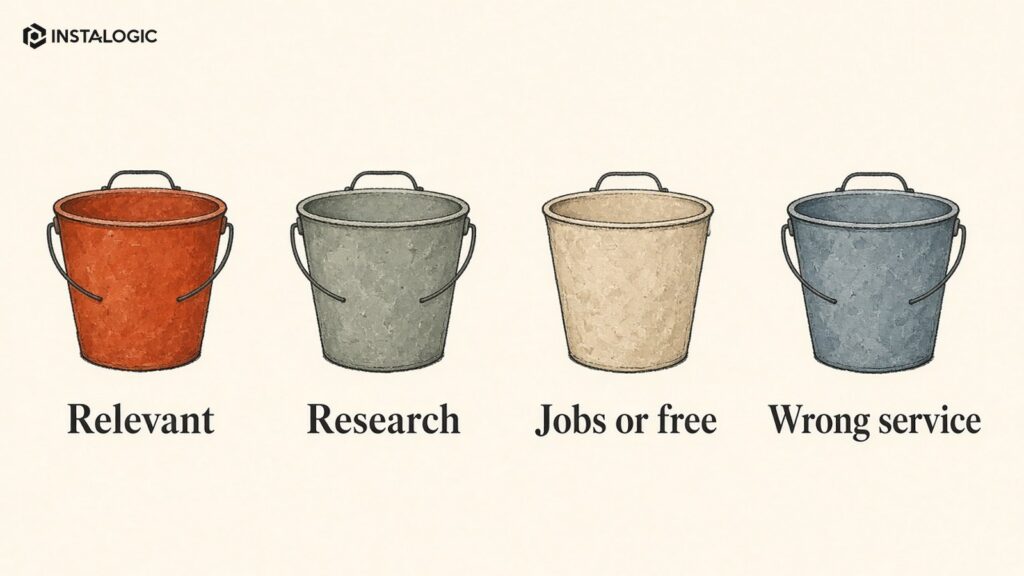
A keyword may match research, jobs, free tools, definitions, competitor support queries or people looking for something you do not sell. Add negative keywords and restructure campaigns around clear intent.
For lead generation, “service/provider/price/near me/consultation” style intent often behaves differently from broad educational searches.
2. Your Match Strategy Is Too Loose
Google's matching systems use more than literal keyword strings. That can help find relevant demand, but it also means advertisers must monitor query quality.
Broad match can work well with strong conversion data and smart bidding. It can also waste budget when conversion signals are poor or the account is new.
Use search-term data, negatives and conversion quality to guide expansion.
3. The Ad and Landing Page Do Not Match
If the ad promises “Enterprise CRM Automation” and the click lands on a generic agency homepage, the visitor has to search again inside your site.
Match the landing page to the query and ad. Repeat the core promise, show relevant proof, answer key objections and provide one clear next step.
Message continuity often matters more than adding more visual effects.
4. The Offer Is Not Strong Enough
Sometimes the visitor understands the page and simply does not want the offer.
Review the value proposition, price expectations, proof, risk and urgency. A “Contact Us” form is not always enough reason for a cold visitor to engage.
Consider a useful audit, consultation, quote, demo or assessment when it fits the service. Do not create fake scarcity.
5. The Form or Mobile Experience Is Losing People
Test the page on the same devices your traffic uses.
Check load time, form length, input behavior, phone fields, CAPTCHA, sticky elements and whether the CTA remains understandable on a small screen.
If users start the form but do not finish, reduce unnecessary fields or split qualification into a later step.

6. Conversion Tracking Is Wrong
Before changing the campaign, verify the conversion definition.
A tag might count page views as conversions, fail to fire on a successful form, double-count, or optimize toward a low-value action such as opening a chat widget.
For lead generation, push lead-quality information back into the advertising/CRM process when possible. Ten spam forms should not teach the bidding system that the campaign is successful.
7. You Are Optimizing for Leads, Not Qualified Leads
Sales feedback matters.
Add a simple CRM status such as qualified, unqualified, spam, opportunity and customer. Review search terms and campaigns against those stages.
If one campaign creates cheap leads that sales rejects and another creates fewer but valuable opportunities, cost per lead alone will send the budget in the wrong direction.
8. Budget Is Spread Too Thin
A small budget divided across many campaigns, locations and services can prevent any segment from collecting enough data.
Prioritize the highest-value service and strongest market first. Learn, then expand.
More campaigns are not the same as more reach if each campaign is underfunded.
A Better Optimization Order
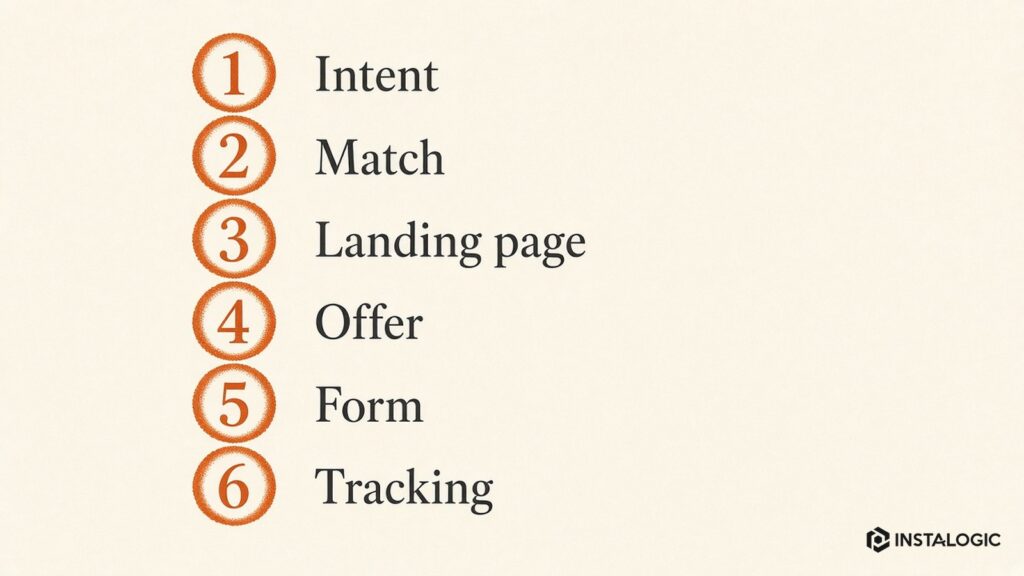
First verify tracking. Then review search terms and intent. Then align ads and landing pages. Then check offer/form/mobile UX. Finally optimize bids and budgets based on qualified outcomes.
This order prevents the team from “optimizing” the media account while a broken landing page or tracking setup remains the real constraint.
Run fewer, more meaningful experiments and document results. Even inconclusive tests are useful when they eliminate weak assumptions.
If users click ads for a specific service but leave quickly, test stronger message match and a clearer explanation of who the service is for. If form starts are high but completions are low, test fewer fields or clearer privacy/next-step information. If visitors consume the page but do not act, strengthen proof and the offer.
Changing button colors randomly is not a conversion strategy. Start with a hypothesis tied to the observed problem.
Landing Page Experiments Should Test a Hypothesis
Over time, use offline conversion import or CRM integrations where appropriate so bidding systems can learn from better signals. The goal is not perfect attribution on day one. It is to stop treating every form as equal.
Create a feedback loop even if it begins manually. Every week, review recent leads with sales and label obvious patterns: wrong country, job seeker, student, too-small company, wrong service, spam, qualified, opportunity. Then compare those labels with campaigns and search terms.
Paid media teams often stop at the form submission because that is where ad-platform tracking is easiest. For B2B and high-consideration services, the most useful information arrives later: was the company a real prospect, did sales connect, was there a valid opportunity, and did it close?
Use Sales Feedback to Improve the Media Account
How to Diagnose Lead Quality by Search Term
Export or review the search terms that generated conversions and join them, where possible, with CRM lead status. Even a manual spreadsheet can reveal patterns. Group terms into qualified, unqualified, ambiguous and irrelevant intent.
Look for repeated modifiers. Job seekers may use 'career', 'salary' or 'vacancy'. Students may use 'course', 'tutorial' or 'free'. Buyers may use 'service', 'agency', 'price', 'consultation' or a product-specific problem. The exact language varies by industry, so build the list from real data rather than generic negative-keyword templates.
Use the findings in three places: negatives and campaign structure, landing-page qualification language, and sales/CRM routing. If a query is relevant but attracts the wrong company size, the ad and page may need to make the target customer clearer rather than excluding the keyword entirely.
Revisit the analysis after major bidding or match-type changes. Automation can expand reach quickly. A recurring search-term-to-CRM review keeps campaign optimization tied to business quality rather than platform conversion counts.
Do Not Scale Until the Funnel Is Stable
A campaign that generates a few good leads at BDT X per lead is not automatically ready for a 5x budget increase. Higher spend can push the campaign into broader auctions and weaker intent. Scale in steps and watch qualified-lead economics, not only platform conversions.
At the same time, make sure sales capacity grows with media. If qualified leads wait two days for a response, campaign optimization cannot repair the lost opportunity. Paid media and sales operations have to scale together.
Frequently Asked Questions
Why does Google Ads spend money but get no leads?
Common causes include wrong search intent, weak landing pages/offers, broken conversion tracking, poor mobile UX or a budget spread too thin.
Should I use broad match?
It can work when the account has good conversion signals, appropriate bidding and active search-term management. It is not automatically right for every campaign.
What is more important: cost per lead or lead quality?
Qualified lead and customer economics are more important. A low CPL can be misleading if most leads are poor fit.