
GEO & AI Search
AEO vs GEO vs SEO: What’s the Difference?
A practical explanation of SEO, AEO and GEO - where they overlap, what is real, what is hype, and how businesses should optimize for modern search.

The Short Answer
SEO is the broad discipline of making content and websites easier for search engines to crawl, understand and surface for relevant searches.
AEO - Answer Engine Optimization - is commonly used to describe structuring useful content so direct-answer systems can understand and present it clearly.
GEO - Generative Engine Optimization - is commonly used to describe improving the likelihood that a brand or source is discovered and cited in generative AI answers.
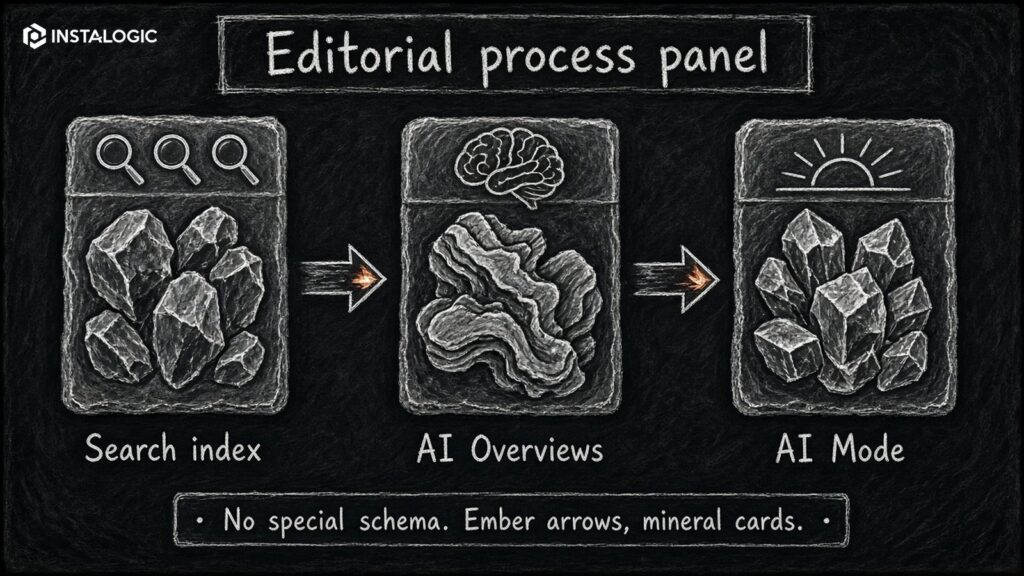
The important point: these are not three independent technical systems. Google explicitly says existing SEO best practices remain foundational for its generative AI features and that there is no special schema or machine-readable file required to appear in AI Overviews or AI Mode.
What SEO Covers
SEO includes technical accessibility, site architecture, page relevance, useful content, internal links, authority, local search and measurement.
It is still the foundation because AI search systems frequently rely on searchable, indexable web content. Google's generative search features retrieve information from its Search index, while OpenAI says public websites can appear in ChatGPT search and advises site owners not to block OAI-SearchBot if they want content to be discoverable.
If basic crawlability, indexing and content quality are weak, an “AI optimization” layer will not rescue the site.
What AEO Tries to Improve
AEO focuses on answering questions clearly.
That means a page should state the answer early, define terms consistently, use descriptive headings and provide enough context that the answer is accurate outside one paragraph. FAQs can help when they reflect real questions, but AEO is not a reason to add hundreds of formulaic question blocks.
Good answer-oriented content often improves ordinary user experience as well. A visitor should not have to read 600 words of introduction before discovering what the page is about.
What GEO Tries to Improve
GEO focuses on how generative systems retrieve, interpret and cite sources.
In practice, that points back to strong web fundamentals plus clear entities, unique information, evidence, freshness and consistent facts. Bing's 2026 AI Performance reporting now shows publishers which URLs are cited in AI answers and the grounding queries associated with those citations.
That is useful because GEO can now be measured in at least some ecosystems instead of being treated entirely as speculation.
Still, no provider can guarantee a citation in ChatGPT, Gemini, Copilot or another model for a particular prompt.
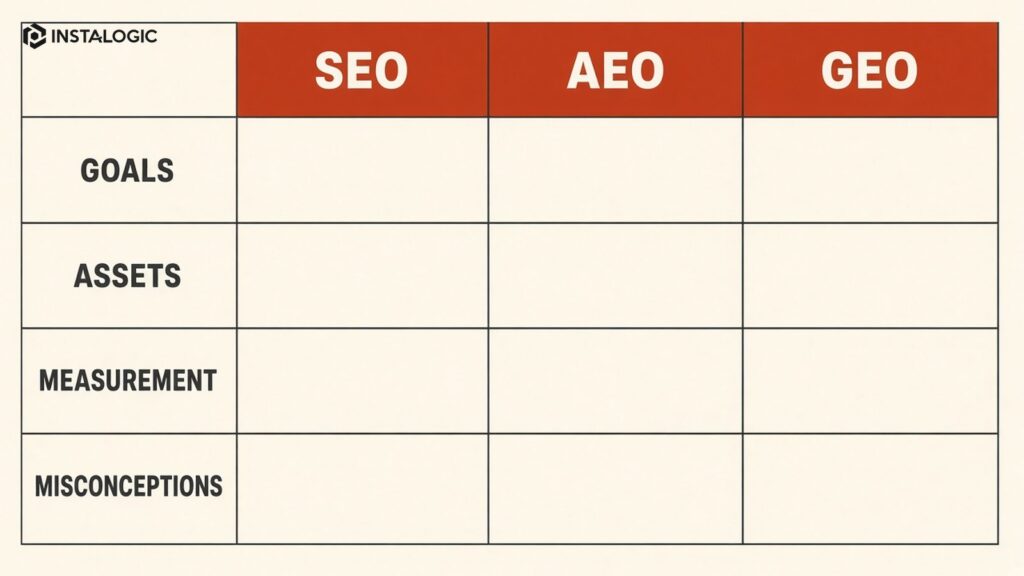
SEO vs AEO vs GEO
- SEO: Optimize discoverability and relevance across search. Core assets: crawlable site, pages, links, content, technical health.
- AEO: Optimize clarity and direct usefulness for question/answer experiences. Core assets: concise answers, structure, definitions, supporting evidence.
- GEO: Optimize discoverability and citation potential in generative experiences. Core assets: authoritative source content, entity clarity, unique evidence, freshness and retrievability.
- Overlap: All three benefit from helpful content, strong information architecture, trustworthy evidence, consistent entities and technical accessibility.
What Google Says About AI Search Optimization
Google's current documentation is unusually clear: there are no additional technical requirements to appear in AI Overviews or AI Mode beyond eligibility for Search, and no special schema is required.
Google's 2026 generative-AI optimization guide emphasizes valuable, unique content and says core SEO remains relevant because generative features use Search ranking and retrieval systems.
That means you should be skeptical of “secret GEO markup,” AI-only sitemap products or claims that conventional SEO no longer matters.
What OpenAI and Bing Add to the Picture
OpenAI says public websites can appear in ChatGPT search and recommends allowing OAI-SearchBot if a publisher wants content to be discovered and clearly cited.
Bing Webmaster Tools now reports AI citations, cited pages and grounding query information across Microsoft AI experiences. Bing also advises site owners to keep content fresh and reduce ambiguity across text, images and video.
These are practical actions: allow relevant crawlers, publish useful source material, keep entity information consistent and monitor where citations happen.
A Practical Optimization Model
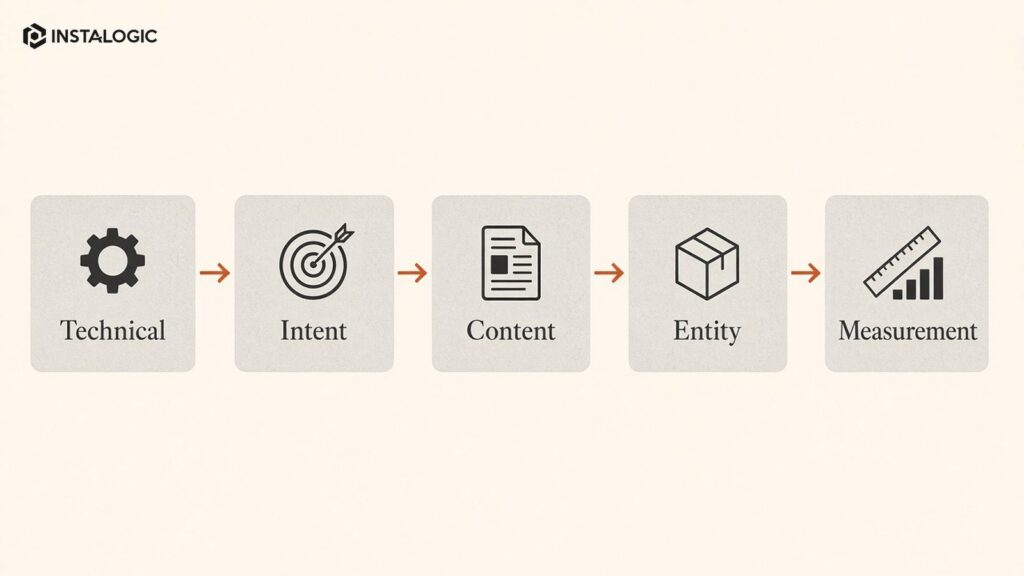
Use one integrated search strategy.
First, fix crawlability, indexation, architecture, internal links and page experience. Second, map commercial and informational search intent. Third, publish original, answer-first content with evidence and useful visuals. Fourth, make company, product, people and location entities clear. Fifth, maintain accurate structured data that matches visible content. Finally, measure traditional search and emerging AI visibility separately.
Do not rename ordinary SEO tasks as GEO simply to make the proposal sound new.
The terminology will continue to evolve. A durable strategy focuses on source quality and discoverability even if the industry eventually changes the labels.
Then improve the content most likely to answer important buyer questions. Add direct answers, original examples, credible sources and useful visuals. Review how those pages perform in traditional search and in available AI visibility reports.
Do not create a separate AEO/GEO team before core search foundations work. Start by auditing indexability, commercial-page quality, content gaps, internal linking, entity consistency and measurement.
What Businesses Should Do First
This is a better model than creating three near-duplicate articles titled 'SEO Cost', 'AEO SEO Cost Answer' and 'GEO Cost for AI'.
The reader experiences one useful article. The three labels describe different optimization priorities inside the same content asset.
Consider the question 'How much does SEO cost?' SEO work makes the page technically accessible, maps the query to the right URL and builds internal relevance. AEO work makes the answer explicit near the top and structures the cost factors clearly. GEO work strengthens the page as a source by adding current market examples, methodology, evidence and an update process.
A Content Example: One Topic, Three Layers
How to Organize an SEO/AEO/GEO Content Brief
Begin with the search intent and the page's job. State the primary audience, decision they are trying to make, target commercial or informational outcome and existing page that could compete with the new content. This protects against cannibalization before writing begins.
Then list the essential questions the page must answer. Mark which question needs a concise answer near the top and which require deeper explanation, examples, tables or evidence. Add the entities that must be unambiguous: company, product, location, platform, regulation or technical term.
Add a source plan. Identify primary or authoritative references for facts that can change, plus any internal experience, screenshots, data or case evidence that will make the article distinctive. A GEO-aware brief should explicitly ask: what does this page contribute that a generic summary does not?
Finish with media and measurement. Specify diagrams, screenshots or comparison tables and where they belong. Define the commercial page the article should support and the metrics to watch after publication. One integrated brief is easier to manage than separate SEO, AEO and GEO checklists.
Terminology Will Continue to Change
AEO and GEO are useful labels because they help teams discuss answer quality and generative discovery, but the industry has not standardized every definition. Different vendors use the terms differently. That is another reason to evaluate the actual work behind the label.
Ask what a provider will change on the website, what new source material will be created, how technical access will be checked and how visibility will be measured. If the answer is clear, the terminology matters less. If the answer is only a promise to 'optimize for LLMs,' ask for specifics.
Frequently Asked Questions
Is GEO replacing SEO?
No. Current Google guidance explicitly says SEO best practices remain relevant and foundational for generative AI search features.
Is there special GEO schema?
Google says there is no special schema.org markup required for AI Overviews or AI Mode. Structured data should accurately match visible content.
Can I make my site appear in ChatGPT search?
OpenAI says public websites can appear in ChatGPT search and recommends not blocking OAI-SearchBot if you want content to be discoverable and cited.
How do I measure GEO?
Measurement is still developing. Bing Webmaster Tools now exposes AI citation data, and Google has introduced dedicated generative-AI performance reporting in Search Console.