
GEO & AI Search
What Is Generative Engine Optimization (GEO) and Why Does It Matter?
GEO explained without hype: how businesses can improve discoverability and citation potential in generative AI search while keeping SEO fundamentals intact.

GEO in One Sentence
Generative Engine Optimization (GEO) is the practice of improving how a brand's web content can be discovered, understood and potentially cited in generative AI experiences.
It is an emerging term, not a standardized search-engine protocol.
The safest way to practice GEO is to build on proven SEO: crawlable pages, unique information, clear entities, evidence, useful media, internal links and accurate current content.
Why GEO Became a Topic
People increasingly use conversational interfaces to research products, compare services and answer complex questions.
Google has AI Overviews and AI Mode. Microsoft surfaces generative answers through Bing and Copilot. ChatGPT can search and cite public websites.
That creates a new visibility question: not only “Do we rank?” but also “Does our information appear as a source when an AI system synthesizes an answer?”
What Google Says
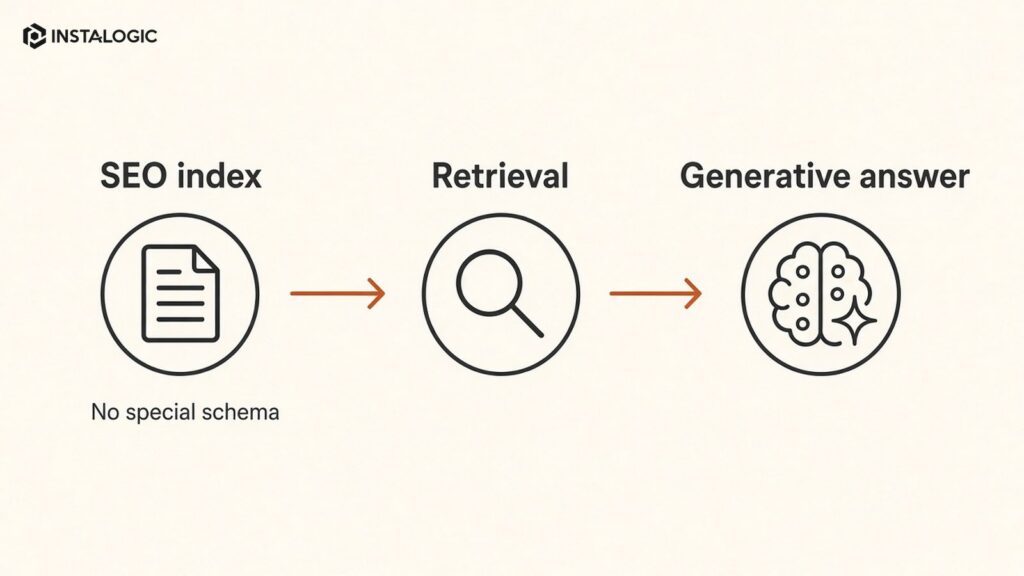
Google says its generative Search features are rooted in existing Search ranking and quality systems. Its current documentation says there is no additional technical requirement, no AI text file and no special schema needed to appear.
That is important because GEO is often marketed as if it requires a separate technical layer.
For Google, the practical foundation remains SEO plus valuable, unique, trustworthy content that the Search system can access.
What OpenAI Says
OpenAI says public websites can appear in ChatGPT search.
For publishers that want their content to be discoverable and clearly cited, OpenAI recommends allowing OAI-SearchBot rather than blocking it in robots.txt. A page can still be excluded using normal indexing controls where appropriate.
This turns crawler access into a concrete GEO checklist item, but access alone does not guarantee citation.
What Bing Adds
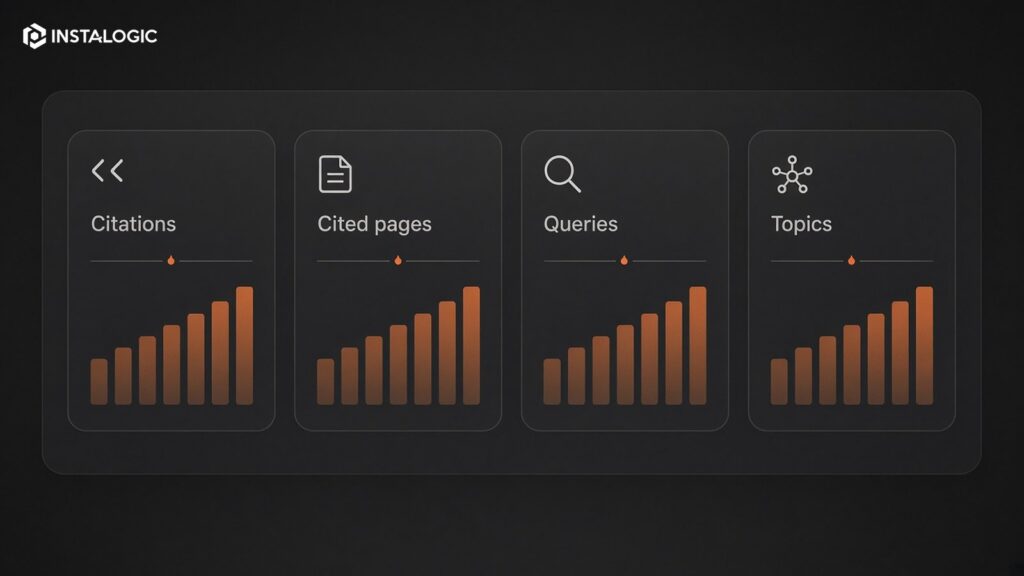
Bing made GEO more measurable in 2026 by adding AI Performance reporting in Webmaster Tools. Publishers can see citation counts, cited pages and samples of grounding queries used to retrieve content.
Bing later expanded AI visibility reporting with intents, topics, citation share and comparison features.
This is useful because teams can observe which source pages are actually being used instead of monitoring only manual prompts.
What Helps AI Discover and Cite Content
- Unique source value: Original data, practical experience, first-hand examples, clear comparisons and expert explanations give a model a reason to use your page.
- Entity consistency: Keep company, product, author and service information consistent across the site.
- Answer clarity: State key facts and definitions clearly rather than burying them in promotional text.
- Evidence: Cite credible sources and distinguish fact from opinion.
- Freshness: Update information that changes, especially prices, platform features and market data.
- Technical accessibility: Allow appropriate crawlers, maintain indexability, internal links and fast reliable pages.
- Useful visuals: Google increasingly surfaces multimodal content; diagrams, screenshots and images should support the text rather than replace it.
What Does Not Count as a GEO Strategy
Publishing hundreds of generic AI-written pages is not a GEO strategy.
Adding imaginary “LLM schema,” an llms.txt file with the expectation that it guarantees citations, or stuffing “ChatGPT” into every page is not a substitute for source quality.
Likewise, manually prompting models every day and treating every mention as a stable ranking metric can produce noisy conclusions because generative answers vary.
How to Build a Practical GEO Program
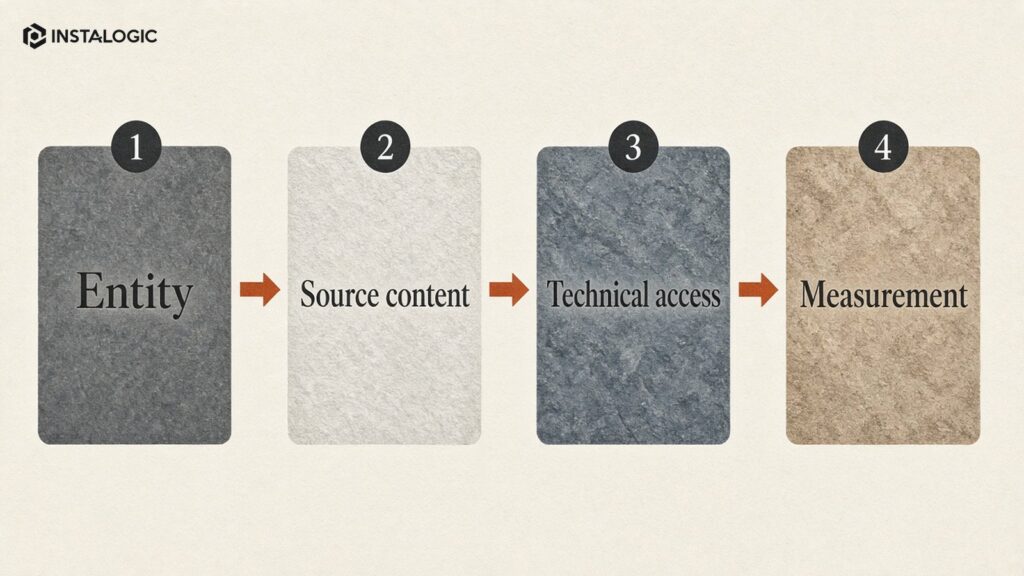
Start with your highest-value topics and entities.
Make commercial pages clear and factual. Publish authoritative supporting content. Add original examples and data where you have them. Strengthen About, author and company information. Keep structured data accurate. Make sure crawlers and search engines can access the content.
Then measure traditional search performance, Google generative visibility, Bing AI citations and AI referral traffic separately.
GEO should extend your search program, not create a second disconnected content factory.
Keep core facts consistent: company name, website, service descriptions, locations and leadership where public. Entity consistency is a basic operational discipline that also supports AI discovery.
Do not pursue mentions simply to create volume. Low-quality syndication and fabricated profiles create noise. Focus on places where real customers, partners and industry participants would reasonably expect the company to appear.
Your own website is only one source in the information ecosystem. Accurate profiles on credible directories, partner pages, industry associations, publications and review sites can reinforce entity understanding.
Brand Mentions and Third-Party Sources
Original value does not always mean proprietary statistics. It can be first-hand process detail, a useful framework, a transparent comparison methodology or a well-documented case example.
The second version gives retrieval systems more specific material to cite, but it also gives a human reader more reason to trust and save the article. That overlap is the core of practical GEO.
A generic article about marketing automation may define the term and list benefits. A stronger source would add an original workflow diagram, a real implementation example, failure modes, a decision framework, current platform references and a clear update date.
Example: Turning an Ordinary Article Into a Stronger Source
How to Create Original Value for GEO Without Proprietary Data
Many businesses assume they cannot create source-worthy content because they do not have a research department. Original value can come from structured experience. Document how your team evaluates a problem, the checklist used in audits, common failure patterns, implementation decisions and the trade-offs you see repeatedly.
Turn real operational knowledge into reusable frameworks. A web agency can publish a migration risk matrix. An SEO team can publish a transparent method for evaluating providers. A software company can document integration patterns and edge cases. These assets are more distinctive than another generic definition article.
Use screenshots and examples responsibly. Remove private data and get permission for client details. If an example is hypothetical, label it as such. The objective is to make the content concrete without fabricating proof.
Update the asset when practice changes. A framework that earns citations can lose value if it still references obsolete platform features or prices. Treat strong source pages as maintained products, not one-time blog posts.
GEO and Commercial Content
Do not focus GEO only on blog articles. Pricing pages, product documentation, integration pages, comparison pages, case studies and company information can all be valuable sources when they contain accurate, specific information.
For service businesses, a well-structured page explaining process, scope, market, proof and limitations may be more useful to an AI system answering a commercial query than a generic thought-leadership article. Source readiness should extend across the entire site.
Measure Source Quality, Not Just Mentions
A brand mention inside an AI answer is useful only if the surrounding information is accurate and the cited source supports the business goal. Review which pages earn citations and whether those pages represent the company well. Improving the source page can be more valuable than chasing a larger raw mention count.
Frequently Asked Questions
Is GEO a real discipline or just a buzzword?
The terminology is emerging, but the underlying visibility problem is real: generative systems retrieve and cite web sources. The practical work overlaps heavily with SEO, content quality and entity clarity.
Can an agency guarantee ChatGPT or Gemini citations?
No. Generative answers are dynamic and controlled by the platform. Providers can improve source readiness and measure visibility but cannot guarantee a fixed citation.
Do I need a special AI sitemap or schema?
Google says there are no special technical requirements or schema needed for AI Overviews and AI Mode beyond normal Search eligibility.